Present
Research Fellow
Nanyang Technological University, SG · School of Electrical and Electronic Engineering

I am a Research Fellow in the School of Electrical and Electronic Engineering at Nanyang Technological University, Singapore. My research focuses on physically interpretable and computationally efficient learning methods for electromagnetic sensing and modelling.
My current work includes AI-assisted ground-penetrating radar for nondestructive tree inspection, physics-informed deep learning for metamaterial modelling and inverse design, multimodal sensing, and numerical methods for complex electromagnetic and multiphysics systems.
Education & Experience
Nanyang Technological University, SG · School of Electrical and Electronic Engineering
Nanyang Technological University, SG · Advisor: Prof. Abdulkadir C. Yucel
University of Illinois Urbana-Champaign, USA · Advisor: Prof. Jianming Jin
Peking University, CHN · Advisor: Prof. Mingyao Xia
University of Electronic Science and Technology of China, CHN
Research
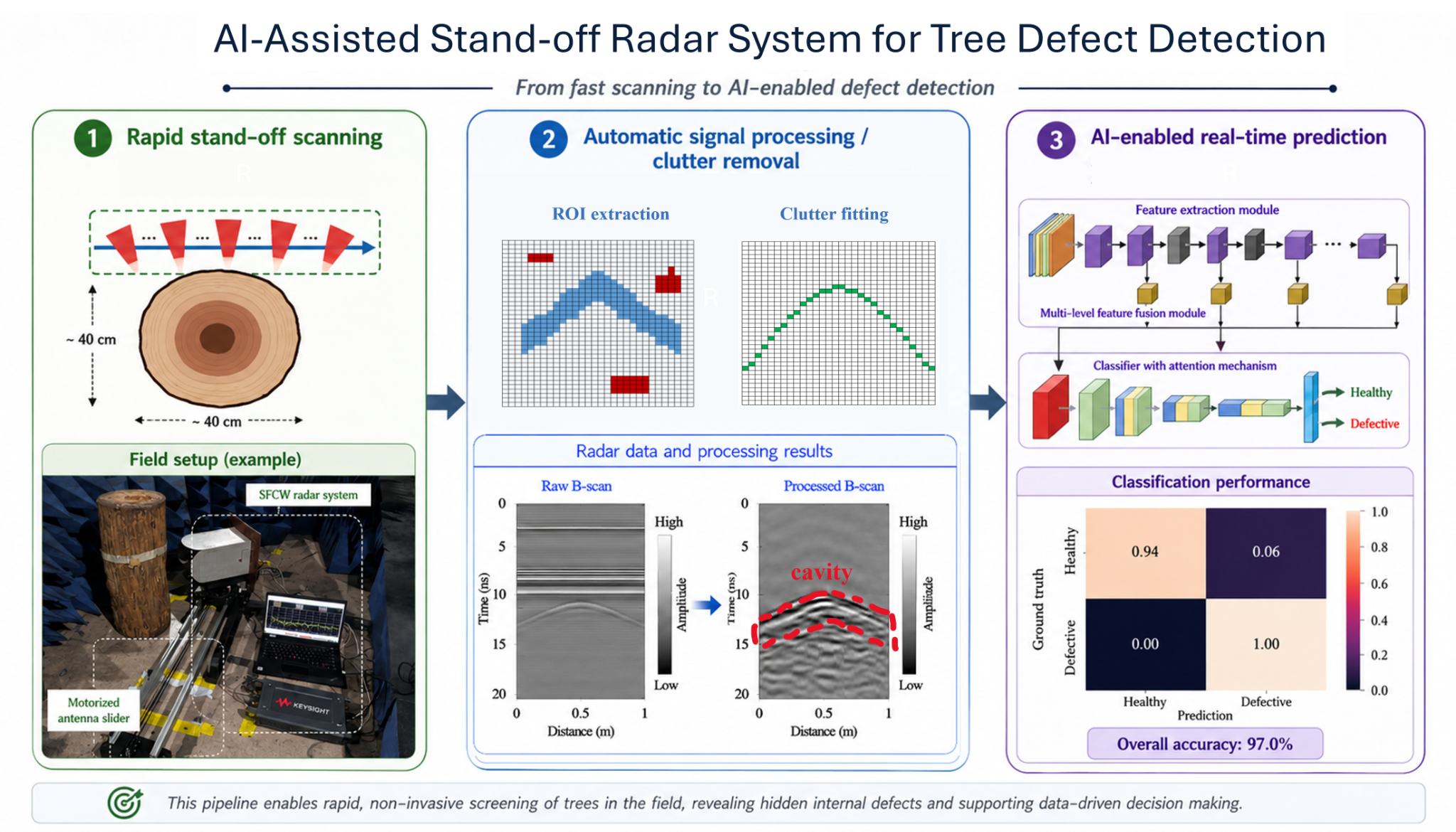
We developed an AI-assisted tree radar system that enables fully automated and rapid nondestructive inspection of internal tree-trunk defects. Using a novel contactless stand-off scanning scheme, the system completes both data acquisition and interpretation within three minutes. A customized signal-processing pipeline suppresses air–bark clutter, while a multilevel feature-fusion neural network detects defect signatures from the radargrams. The system achieves 96% detection accuracy on real trunk samples and 80% in live-tree field tests.

We developed a physics-assisted AI framework for reconstructing permittivity maps and defect geometries inside cylindrical objects from GPR data. The scheme combines data-driven dual-permittivity estimation, physics-based modified Kirchhoff migration to bridge the mismatch between B-scan and imaging domains, and learning-based shape refinement for high-quality defect reconstruction. We applied the proposed framework to tree-trunk defect imaging, where its performance on synthetic cylindrical models, measured trunk samples, and live-tree field tests demonstrates its robustness in realistic scenarios. The underlying principle is also extendable to other enclosed or curved structures, such as bridge piers, building columns, and similar cylindrical objects.
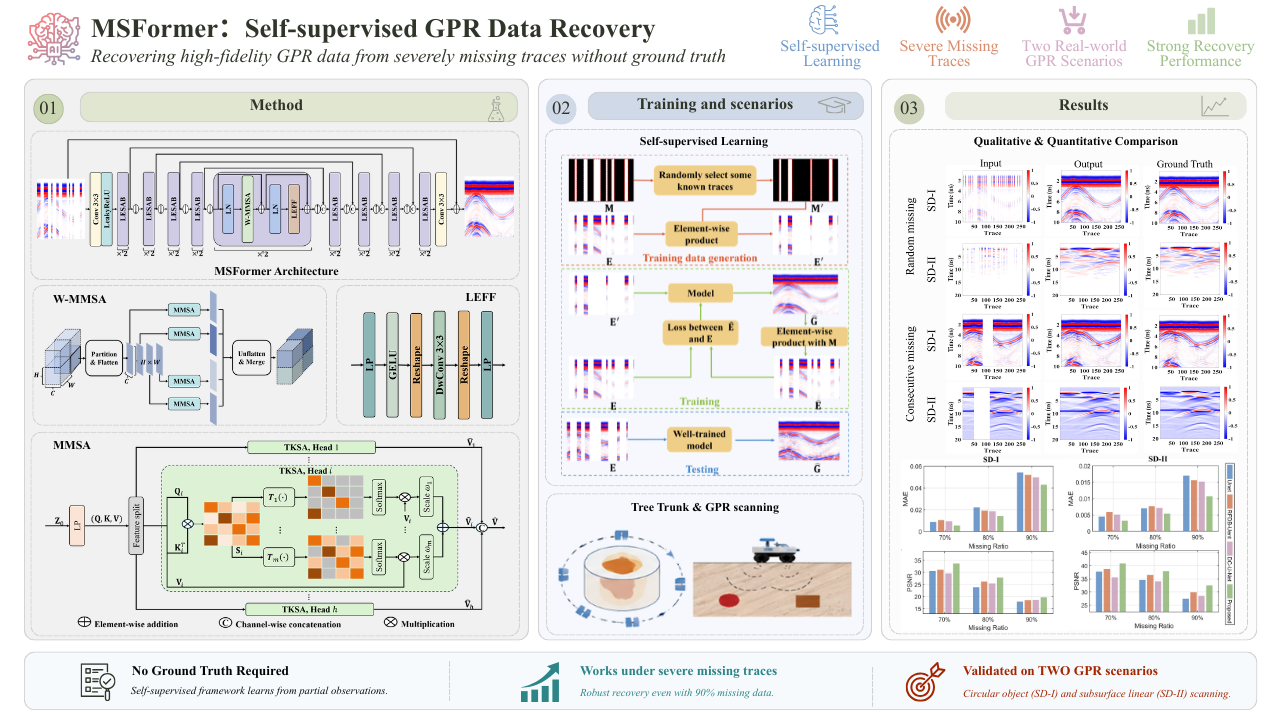
We proposed a self-supervised multisparsity transformer for reconstructing heavily corrupted GPR B-scans with large missing-trace regions. The model adopts a hierarchical U-shaped architecture and multi-sparsity attention to capture both local and global features from incomplete radar data. Without requiring fully sampled B-scan labels, the method achieves robust reconstruction across linear subsurface scanning and circular scanning of cylindrical objects. It outperforms CNN-based reconstruction models on both synthetic and measured datasets, improving the interpretability of incomplete GPR data and supporting downstream detection and imaging tasks.
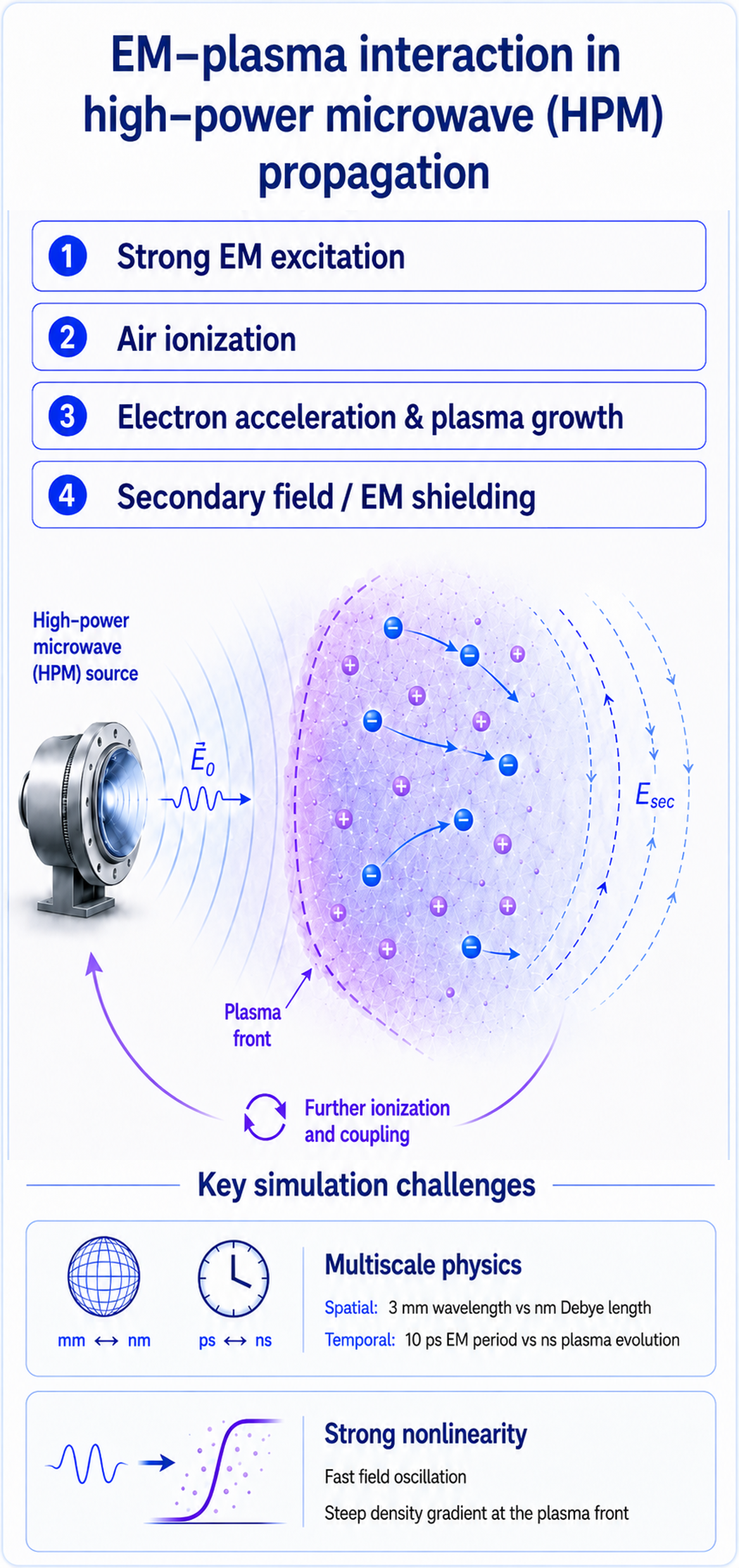
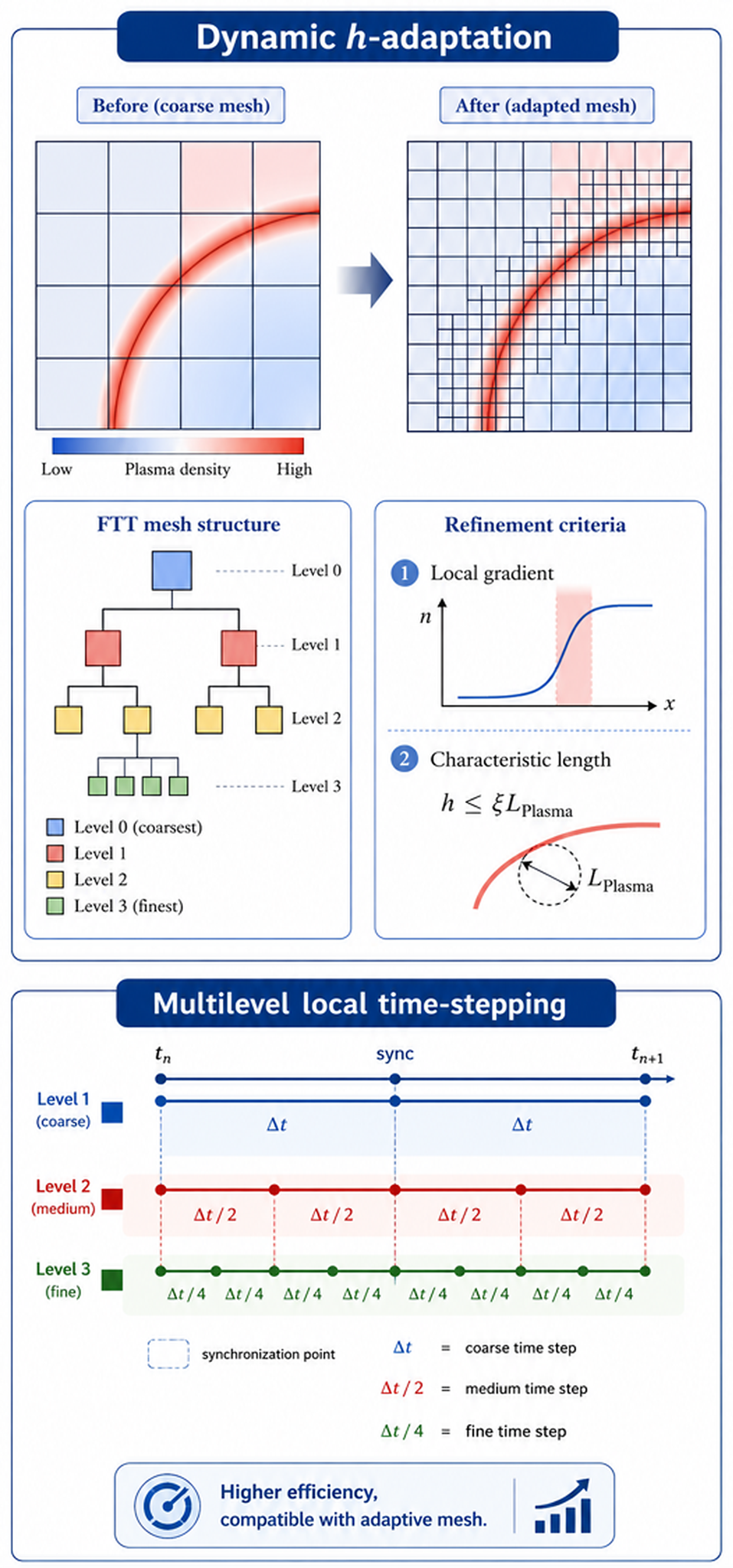
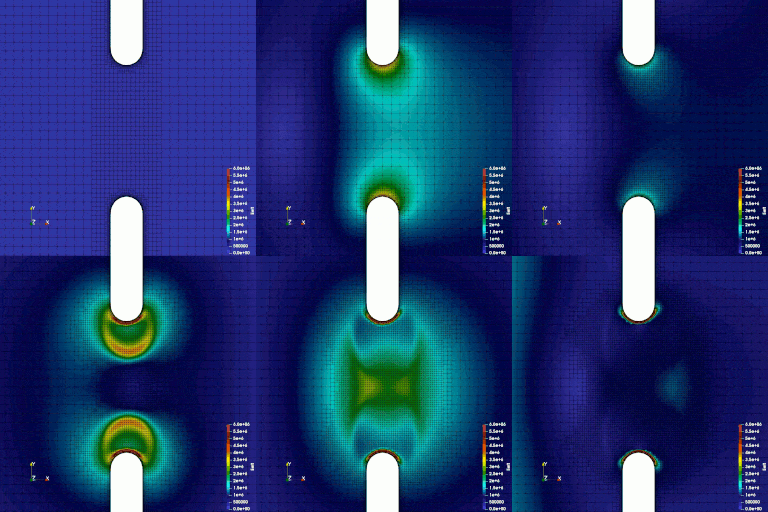
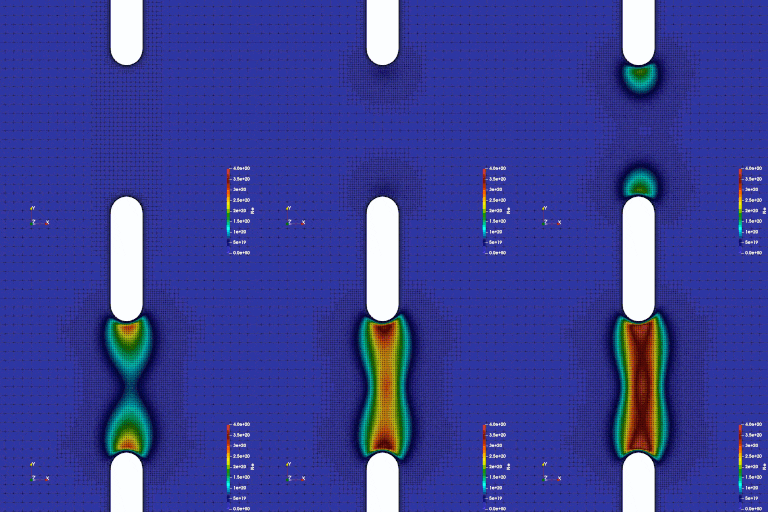
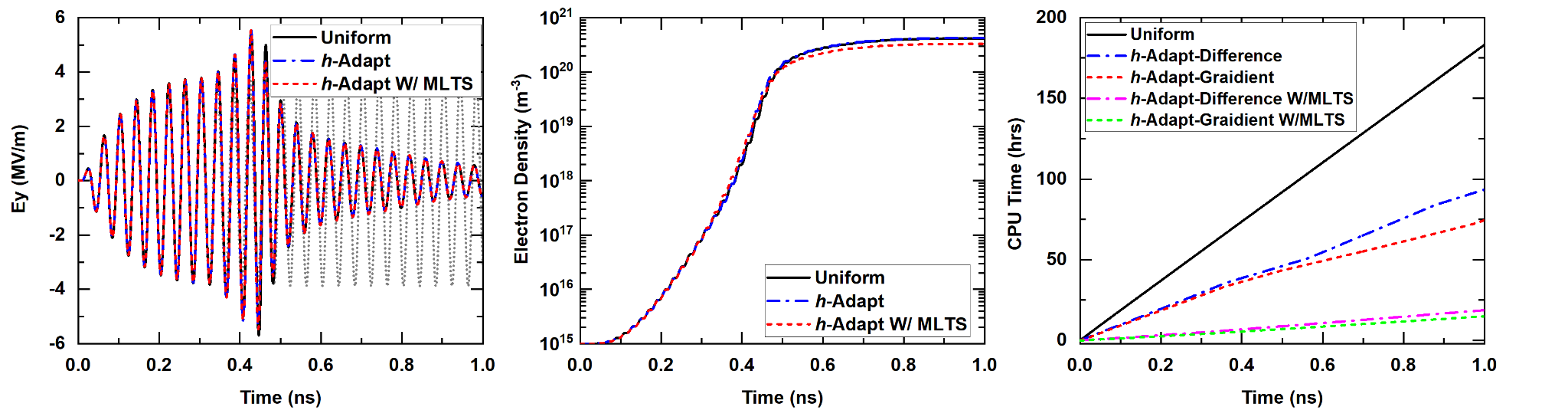
We developed high-order time-domain solvers with dynamic mesh adaptation and multirate integration for coupled electromagnetic–plasma problems, including high-power microwave air-breakdown phenomena. The proposed method automatically refines the mesh in regions with strong physical variations during time-domain simulation, enabling efficient resolution of multiscale and rapidly evolving fields while achieving approximately 10× improvement in computational efficiency.

We developed a coupled multiphysics simulation framework for analyzing electromagnetic scattering from hypersonic cone-like bodies flying in near space. The framework first resolves the plasma sheath generated by high-speed aerodynamic heating through fluid-dynamics modeling, including electron density, collision frequency, and gas temperature distributions. These plasma properties are then converted into spatially varying complex dielectric parameters and incorporated into a volume-surface integral equation solver to evaluate the electromagnetic scattering response of the body–plasma system. The study reveals how flight velocity, attack angle, and altitude affect plasma-sheath formation and backscattering radar cross-section, providing physical insights for radar sensing and scattering analysis of hypersonic targets.
News
We developed an AI-assisted tree radar system for contactless stand-off scanning of tree trunks, completing data acquisition within two minutes per tree. By integrating embedded signal processing with well-trained deep learning models, the system enables real-time field detection of internal tree-trunk defects.
NTU highlighted the team's radar innovation for detecting internal tree-trunk defects within minutes, developed in collaboration with Singapore's National Parks Board.
Read more on NTU homepage → Read the NTU media release →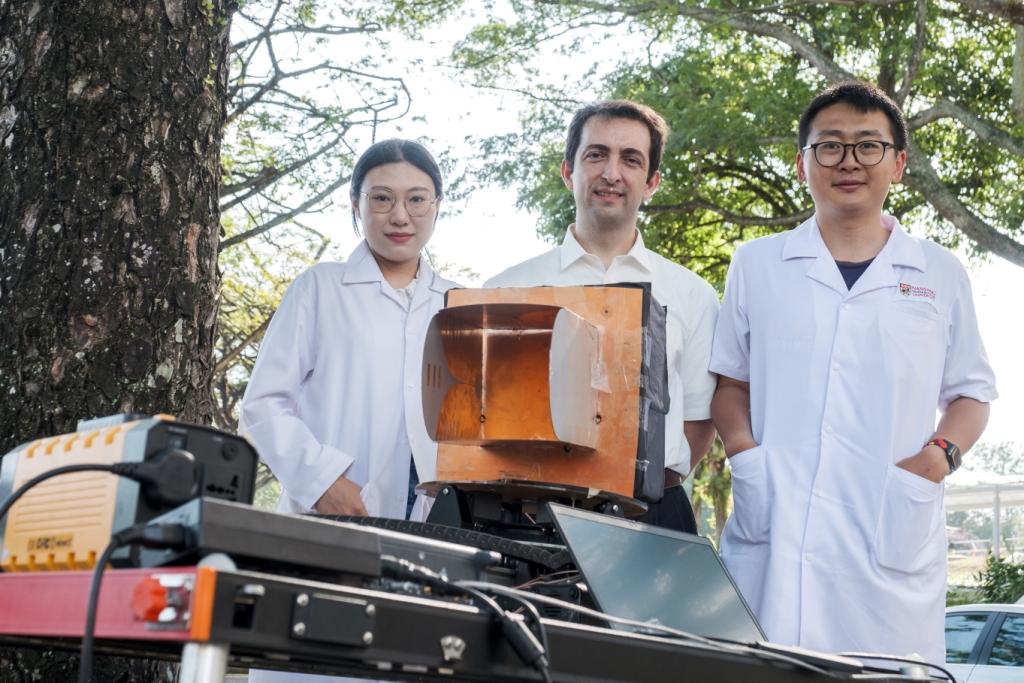
NTU EEE featured the research team's work on contactless radar scanning and AI-assisted detection for routine health checks of urban trees.
Read the NTU EEE feature →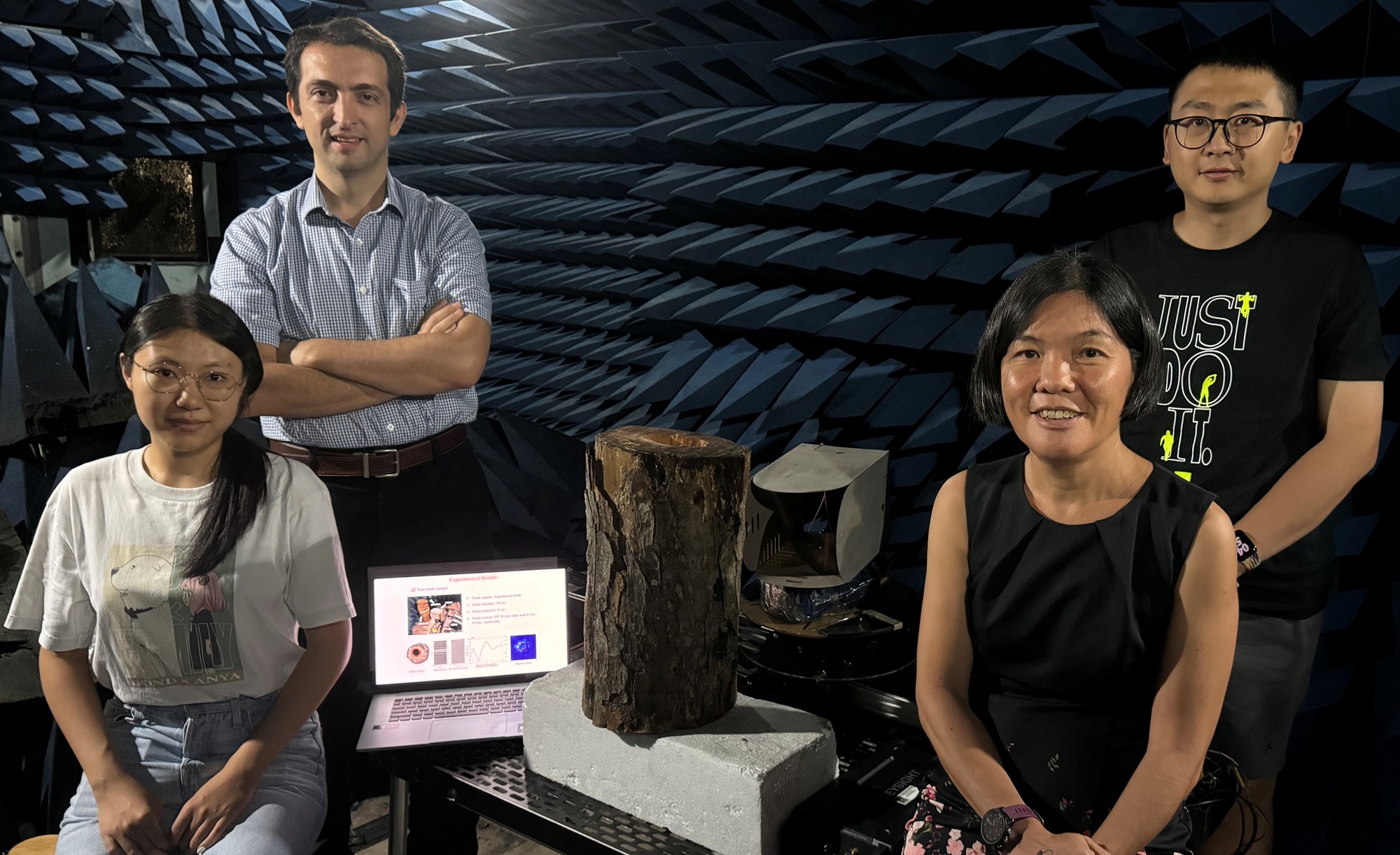
Journal Publications
J. Qian, Y. H. Lee, K. Cheng, Q. Dai, M. L. M. Yusof, J. Wang, and A. C. Yucel
IEEE Transactions on Geoscience and Remote Sensing, vol. 64, pp. 1–18, 2026.
J. Qian, Y. H. Lee, K. Cheng, M. L. M. Yusof, J. Wang, and A. C. Yucel
IEEE Journal of Selected Topics in Applied Earth Observations and Remote Sensing, pp. 17344–17362, 2026.
K. Cheng, Y. H. Lee, J. Qian, M. L. M. Yusof, J. Wang, and A. C. Yucel
International Journal of Numerical Modelling: Electronic Networks, Devices and Fields, vol. 39, issue 3, 2026. Invited article.
J. Qian, Y. H. Lee, K. Cheng, Q. Dai, M. L. M. Yusof, D. Lee, and A. C. Yucel
IEEE Transactions on Geoscience and Remote Sensing, vol. 62, pp. 1–15, 2024. Highlighted by NTU.
Q. Dai, Y. H. Lee, H. H. Sun, J. Qian, M. L. M. Yusof, D. Lee, and A. C. Yucel
IEEE Journal of Selected Topics in Applied Earth Observations and Remote Sensing, vol. 17, pp. 19668–19681, 2024.
K. Cheng, Y. H. Lee, J. Qian, D. Lee, M. L. M. Yusof, and A. C. Yucel
Sensors, vol. 24, no. 13, 4170, 2024.
Q. Dai, Y. H. Lee, H. H. Sun, J. Qian, G. Ow, M. Lokman, and A. C. Yucel
IEEE Geoscience and Remote Sensing Letters, vol. 19, 2022.
S. Yan, J. Qian, and J. Jin
IEEE Journal on Multiscale and Multiphysics Computational Techniques, vol. 4, pp. 76–87, 2019.
J. Qian, H. Zhang, and M. Y. Xia
International Journal of Antennas and Propagation, vol. 2017, Article ID 3049532, 11 pages, 2017.
K. Cheng, Y. H. Lee, J. Qian, Q. Dai, M. L. M. Yusof, J. Wang, and A. C. Yucel
Submitted to IEEE Transactions on Geoscience and Remote Sensing.
Academic Service
Reviewer for journals including:
Contact
For research discussions and collaboration opportunities, please contact me by email.